Field notes for grades 3 to 5
Wren and Sitka's Field Notebook
25 Nature Investigations for Curious Kids
Twenty five investigations. One pencil. Whatever is outside your door.
Each lesson teaches one real idea, gives your child something to do with it, and ends with a reason to step outside. No kit, no login, and no science background needed.
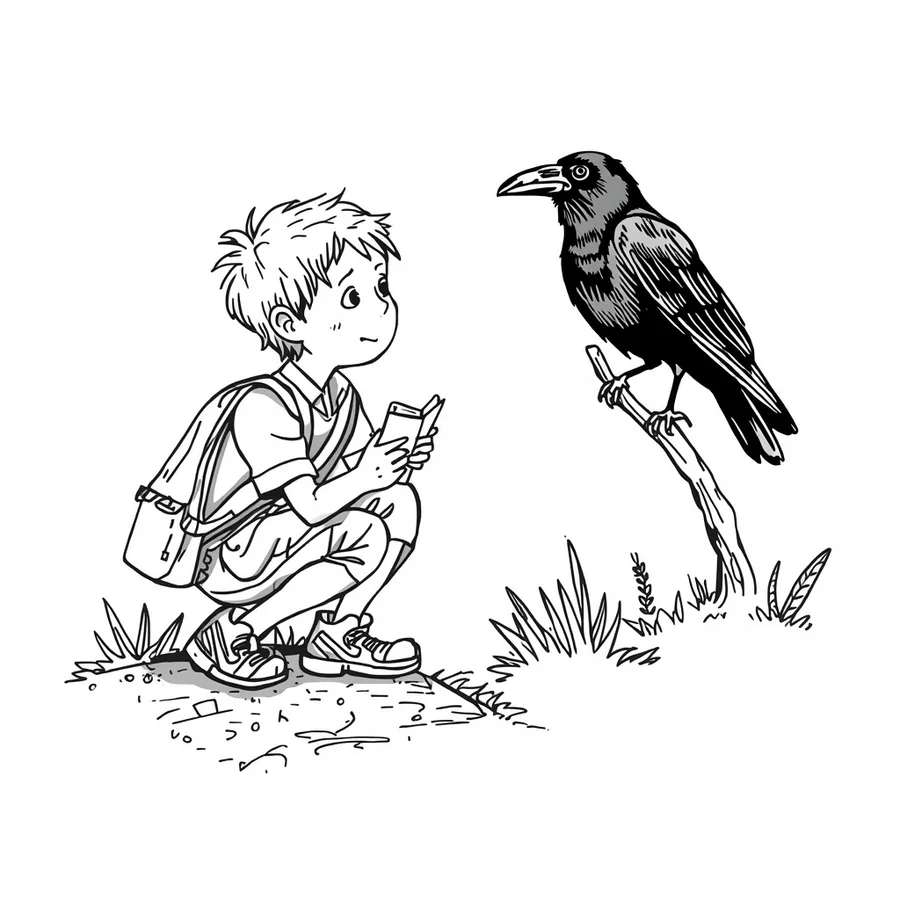
The teaching idea
Science that leaves the worksheet
-
Read the teaching page
Start together. The LEARN side carries the science your child needs for that investigation, in plain language and with the picture doing real work.
-
Let your child try it
The second page turns the idea into a drawing, comparison, model, or short explanation. The answer is never a hunt through another book.
-
Take the prompt outside
Every investigation ends with one small thing to notice outdoors. A cloud, a track, a leaf, a shadow, or the ground under your feet is enough.
-
Use the grown-up help
A short grown-up strip sits on every activity page, and the bundle includes the complete answer key. You do not need to remember fourth-grade science first.
Use one investigation in twenty minutes, stretch it across an afternoon, or follow a question into the next week. The notebook does not care where Tuesday went.
The full field list
25 things worth going outside to notice
-
What Makes Something Alive?
Field note: A thing has to do every job on the list, not just one or two. That is why fire and rivers fool people.
-
Reading Tracks
Field note: Claw marks are the fastest way to tell a dog family track from a cat family track. Cats retract, dogs do not.
-
Beaks and What They Eat
Field note: A beak is an adaptation. It matches the food that is actually there, because a bird whose beak suits its food feeds well and raises more chicks.
-
Feathers and Flight
Field note: Run your fingers the wrong way down a feather and it splits. Smooth it back and it seals. Those are the barbules hooking and unhooking.
-
How Smart Is a Raven?
Field note: Moving hidden food only makes sense if the raven understands that another animal saw it. That is a big idea called knowing what somebody else knows.
-
The Complete Change
Field note: The caterpillar and the butterfly eat different food on purpose. They are not competing with each other for the same meal.
-
The Salmon's Journey
Field note: The salmon carries ocean nutrients hundreds of miles inland and leaves them in a forest. Trees near salmon streams grow measurably faster.
-
Who Eats Whom
Field note: The arrow points toward the eater, because the arrow is showing where the energy went, not who is eating.
-
It Is Not a Line
Field note: The more arrows an animal has pointing away from it, the safer the web is if that animal disappears. Variety is a kind of insurance.
-
Predator and Prey
Field note: Eyes in front, born to hunt. Eyes on the side, born to hide. It works on almost every animal you will meet.
-
Hiding in Plain Sight
Field note: Camouflage says do not see me. Mimicry says you have seen me and you should be worried. They are opposite strategies.
-
Three Ways to Survive Winter
Field note: None of the three is best. Each one trades a different cost. Migration costs energy, hibernation costs time, and staying costs constant work.
-
How a Tree Drinks
Field note: The tree does not push water up. The leaves let water go, and the rest of the column follows because water sticks to itself.
-
Reading Time in a Stump
Field note: One year is one light band plus one dark band, not one line. Counting only the dark lines gets you the right answer, and counting every band gets you double.
-
How Seeds Travel
Field note: A berry is a bribe. The plant spends energy making sweet fruit purely to get an animal to carry the seed somewhere new.
-
How a Leaf Eats Light
Field note: Leaves are not green because green is useful. They are green because green is the color the plant throws away.
-
What Dirt Is Made Of
Field note: Topsoil is not a renewable thing on a human timescale. Hundreds of years to make an inch, and a bad storm on bare ground can take it in an afternoon.
-
Three Kinds of Rock
Field note: Look for layers and you are probably holding sedimentary. Look for visible crystals and you are probably holding igneous. Look for bands or a shiny squashed grain and you are probably holding metamorphic.
-
Water Goes in Circles
Field note: The amount of water on Earth has not changed in a very long time. It is the same water, going around and around.
-
Reading the Sky
Field note: Nimbus means rain. Cumulus means heaped up. Stratus means layered. Cirrus means a curl of hair. The names describe exactly what you are looking at.
-
Weather Is Not Climate
Field note: One day is weather. Thirty years is climate. Anybody arguing about climate using yesterday is using the wrong size of evidence.
-
Why the Moon Changes Shape
Field note: Phases are about your viewing angle, not about a shadow. Earth's shadow only lands on the moon during an eclipse, which happens rarely.
-
Finding North Without a Compass
Field note: The North Star is not the brightest star in the sky. It is the one that does not move, and that is worth far more.
-
Putting It All Together
Field note: A habitat is an address. A niche is a job. Two animals can share an address, but not a job.
-
Keeping a Field Journal
Field note: Observation is what you saw. Inference is what you think it means. Keep them in separate sentences and you are doing science.
Three ways in
Buy the lesson you need, or keep the whole trail
Pick one investigation
Eight stand-alone lessons for the school topics people most often need right now.
- Living and Nonliving Things $2 Open on TPT
- Compass Rose and Cardinal Directions $2 Open on TPT
- Water Cycle $2 Open on TPT
- Photosynthesis: How a Leaf Eats Light $2 Open on TPT
- Moon Phases $2 Open on TPT
- Butterfly Life Cycle and Metamorphosis $2 Open on TPT
- Food Chain: Who Eats Whom $2 Open on TPT
- Types of Rocks $2 Open on TPT
Take a paired trail
Eight two-lesson packets that put naturally connected ideas beside each other.
- Living and Nonliving Things + Habitats $3 Open on TPT
- Water Cycle + Types of Clouds $3 Open on TPT
- Photosynthesis + How a Tree Drinks $3 Open on TPT
- Moon Phases + Finding North by Stars $3 Open on TPT
- Butterfly Life Cycle + Seed Dispersal $3 Open on TPT
- Food Chains + Food Webs $3 Open on TPT
- Types of Rocks + What Soil Is Made Of $3 Open on TPT
- Animal Adaptations: Beaks + Camouflage $3 Open on TPT
Keep the whole field notebook
All 25 investigations, the complete answer key, the grown-up notes, and the whole Wren and Sitka sequence in one printable bundle.
Prefer a bound book? The paperback version is prepared for print. I will add its Amazon link here once the listing is confirmed.
Keep the notebook open
One email when something useful is ready
The useful stuff goes on the One Size Fits One blog. Put your email here and you will get one welcome note, then one email when a new post goes up. I will also tell you when another Wren and Sitka investigation exists. No drip, nothing you did not ask for.
Who made this
The Accidental Teacher
Scott Somers. I taught middle school in Glennallen, Alaska, and now I am a homeschool dad and homeschool coach. Wren and Sitka came from the same question behind everything my family builds: what would this look like if the plan had to fit the child?